How Air Gap Faucets Work
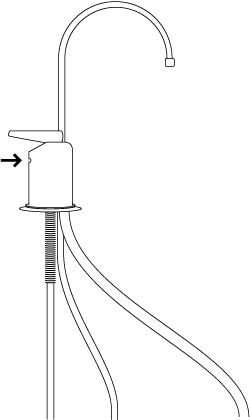
Air gap faucets are used with undersink reverse osmosis units. They are never used with filters because the air gap is not needed.
The purpose of the air gap faucet is not only to deliver drinking water from the RO unit, as all faucets do, but also to provide an "air gap" for the RO unit's drain system.
An "air gap" is a siphon break to assure that drain water cannot flow backward from the household drain system into the reverse osmosis unit.
Note in the picture above that the tubes are of different diameters. The smaller tubes are 1/4" and the larger tube is 3/8".
The tube on the left in the picture delivers the "permeate" or purified water to the user via the tall spout when the faucet's handle is pressed. The other two tubes are parts of the drain systems.
Reverse osmosis units produce waste water when they are in operation. This waste water comes up the center tube in the picture and is released into a small open trough inside the base of the faucet. The drain water flows along the open trough until it falls through a hole into the top of the larger tube on the right in the picture. The large tube connects to the undersink drain pipe. Water falls by force of gravity down the large tube and into the undersink drain pipe.
 |
|---|
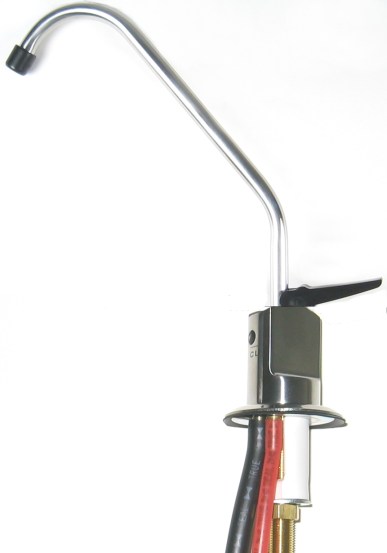
| Classic Air Gap Design. The RO drain water goes up to the faucet in the red tube, then down to the sink's drain pipe in the black. The permeate tube connects to the threaded metal stem. The hole in the faucet body serves as an overflow drain if the black tube is obstructed. |
More about air gap faucets
If the air gap faucet leaks water onto the sink, it is usually because the drain line, the larger of the tubes, is stopped up. The drain hole, indicated with the arrow in the top picture, is an escape hole so that drain water can have a way out if the drain line stops up. The problem can usually be fixed by removing the drain line at the bottom end and clearing out the obstructions. Or, the obstruction may be in the drain saddle or the drain pipe itself.
Since the 3/8" tube delivers water by force of gravity alone, any small obstruction (a small piece of food from the drain pipe, for example) can block it.
Since air gap faucets are often unpopular with homeowners because of noise and messes on the sink when the drain line blocks, some manufacturers provide reverse osmosis with standard faucets. A standard faucet has only the permeate line, the one on the left. The RO drain line connects directly to the undersink drain.
Some RO builders use standard faucets but provide one or more one-way valves (called "check valves") to guard against backflow from the drain.
Plumbing codes differ from place to place, but most still require the air gap faucet. It should be noted, however, that this is a provision of the plumbing code that is frequently overlooked.
How to Install an Airgap Faucet
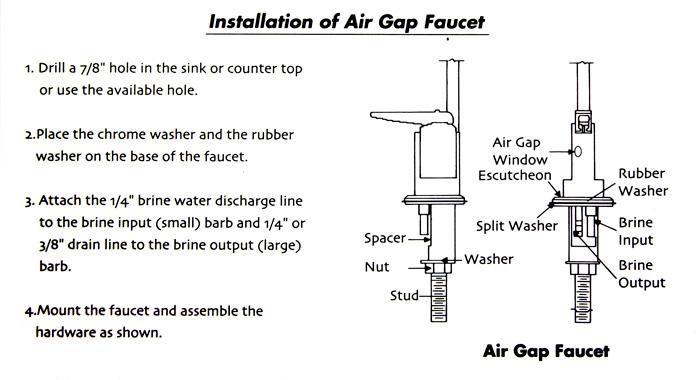
Every faucet is different, but the generic instructions above can be applied to most.
More about airgap faucets.