How Reverse Osmosis Tanks Work
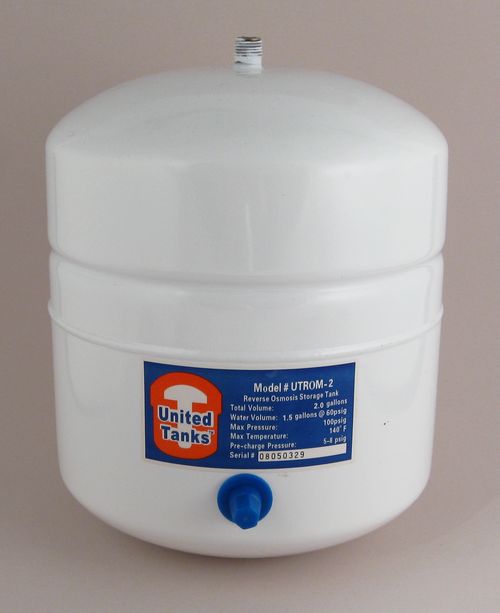
Pressure tanks used with undersink reverse osmosis units are miniature versions of pressure tanks used on residential water wells.
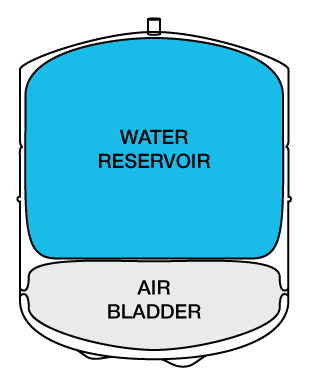
Water is stored in a bladder, made of a material called butyl. When there is a demand for water, the water is pushed out of the tank's bladder by air pressure.
In the picture, the stem at the top of the tank is where water both enters and leaves the tank. The blue cap on the front near the bottom covers a standard Schroeder air valve, like the valve on a bicycle or automobile tire. This is where air is pumped into the tank. The air valve on some tanks is in a different place, so you may have to look for it. In older Amtrol tanks, the air valve is located inconveniently on the bottom of the tank.
When the RO tank is empty of water, it should have a pressure of five to 10 psi air. As water is forced into the tank by operation of the RO unit, pressure inside the tank increases. Standard RO units have a hydraulic shutoff valve that stops production of water when the pressure in the tank reaches approximately 2/3 of the pressure of the tap water that supplies the RO unit. Thus, if your city water pressure is 60 psi, the RO unit will fill the storage tank to around 40 psi before shutoff. If, however, your city pressure is only 50 psi, the RO unit will stop filling the tank when the pressure in the tank reaches a bit over 30 psi. This may make it difficult to supply an icemaker with your RO unit.
Here is a stylized view of what it looks like on the inside of an RO tank. Actual interior construction of tanks may differ, but the illustration shows the basic arrangement.
Misconceptions about RO tanks
The biggest misunderstanding about RO tanks is that they hold the amount of water that the tank manufacturer says. They actually hold much less. That's because much of the inner space of the tank is occupied by air and a heavy bladder. Typically, you'll get about 2.5 gallons of water out of what is commonly called a 4 gallon RO tank.
Another common misunderstanding is the belief that the tank's external material affects the quality of the water. Actually, the water you're going to drink doesn't touch the metal or plastic that the tank is made from. Except for the spout at the top, which is stainless steel on most modern metal tanks, the water does not touch the metal. The water contacts only the butyl bladder. Butyl has been used for years for RO tanks and well tanks and is regarded as inert.
The storage tank is the source of the most common problems with undersink RO units. Not enough air in the tank results in not enough water at the faucet. Too much air also results in not enough water at the faucet.
Here are some RO tank styles to look at.